AI Overview · Cluster Guide
Does Google's AI Overview Kill Organic Traffic? What the Data Actually Shows
A publisher we spoke with described watching a core traffic graph "fall off a cliff" the same month AI Overviews rolled out more broadly to their category. Someone else in the same conversation swore they'd seen no change at all. Both were telling the truth about their own site. Here's what the aggregate data actually says.
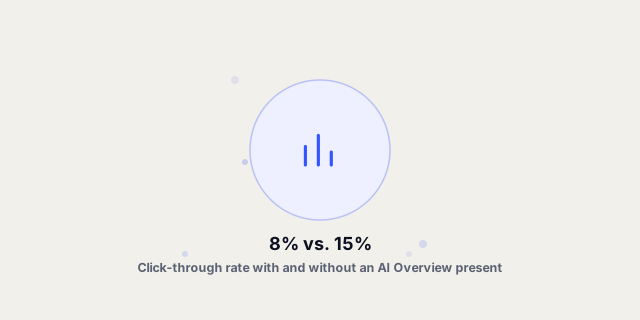
Yes, measurably — but unevenly. Pew Research Center's behavioral study of real Google searches found users clicked a traditional result about 8% of the time when an AI Overview was present, versus roughly 15% without one — close to half the click-through rate. The impact is heavily concentrated in informational queries; transactional and navigational searches are far less affected.
Two People, Two Completely Different Experiences
Both reactions in that opening story are real, and reconciling them is the whole point of this piece. A site built almost entirely around broad informational content — "what is," "how to," definitional queries — sits squarely in the category where AI Overview absorbs the most clicks. A site built around transactional, comparison-heavy or highly specific long-tail queries sees a much smaller effect, because those queries trigger AI Overviews less often and drive click-through even when they do.
The Data, Stated Plainly
Pew Research Center ran one of the more methodologically credible studies on this question — a behavioral analysis of tens of thousands of actual Google searches, not a survey asking people to recall their own behavior. It found that when an AI Overview appeared, users clicked through to a traditional web result only about 8% of the time, compared to roughly 15% when no AI Overview was present. That's close to a 50% relative drop in click-through specifically attributable to the presence of the feature.
Separately, research covered by Search Engine Land, drawing on SparkToro's ongoing tracking, has found AI Overviews now appear on more than one in five Google searches, and click-through rate drops by close to 60% on the queries where they do appear. The two studies use different methodologies and land on somewhat different specific numbers, which is itself an honest signal: this is still a young measurement area, and anyone quoting a single precise figure with total confidence is overstating how settled the data actually is.
“The honest answer isn't a single number. It's: yes, meaningfully, and it depends enormously on what you publish.”Chenthil Kumar, Digimarketlabs
Which Content Categories Are Actually Affected
- Hit hardest: broad informational content. Definitional queries, general how-to content, and anything an AI system can fully answer without needing to send someone to a page.
- Less affected: transactional and commercial queries. "Buy," "book," "hire," "price" queries still tend to require an actual visit to complete the action.
- Largely unaffected: navigational and brand queries. Someone searching your brand name by name is looking for you specifically, not a synthesized summary.
Not sure how exposed your content mix actually is?
We'll map your top-traffic pages against query type and show you exactly where the real AI Overview risk sits.
The Part That Doesn't Show Up in a Click-Through Number
Being cited inside an AI Overview has value even without a click — brand visibility and implied credibility from being one of the sources an AI system trusted enough to cite. It's a different kind of value than a click, and it's a genuinely harder one to measure, but dismissing it because it doesn't show up in Google Analytics would be its own kind of measurement error.
So What Should You Actually Do About It?
- Audit your content mix honestly. If a large share of your traffic comes from broad informational queries, that's your exposed surface area.
- Push commercial and transactional content, not just informational. These queries are structurally more resistant to zero-click absorption.
- Try to be the cited source where you can't be the click. See our guide to AI Overview optimization for how.
- Diversify beyond Google organic as a single channel, since this shift isn't specific to one search engine — see our guide to GEO for the multi-engine picture.
FAQ
AI Overview traffic impact, answered directly
Is every website losing traffic to AI Overview equally?
No — the impact concentrates heavily on broad informational content. Transactional, navigational and highly specific long-tail queries are far less affected.
Should I stop publishing informational content?
No, but it's worth balancing it more deliberately with commercial and transactional content, and treating informational pages as much for citation and authority-building as for direct clicks.
Is this trend specific to Google, or happening everywhere?
It's part of a broader shift across AI-native search — ChatGPT Search, Perplexity and Copilot show comparable or even higher zero-click rates in some studies. See our guide to GEO for the cross-engine picture.
Can I measure this impact on my own site?
Partially — Search Console shows impressions and clicks but doesn't isolate AI Overview citation specifically, which is exactly the gap our guide to tracking AI Overview citations addresses.
Want an honest read on your own exposure?
Book a strategy call and we'll show you which of your pages are genuinely at risk — and which aren't.
Sources & further reading
Where this guide draws from
Keep reading