SEO · GEO · AIO · South Korea
SEO, GEO and AIO Services for Businesses in South Korea
Independent search and AI visibility work for companies in South Korea, run from Chennai by one named practitioner. Start with a free review of your site, your search presence and where AI assistants mention you.
SEO, GEO and AIO services for businesses in South Korea are search optimization work that helps a company appear in Google and Bing results, and be cited by AI assistants such as ChatGPT, Perplexity, Copilot and Google AI Overviews, for the searches its buyers in South Korea actually make.
Key Takeaways
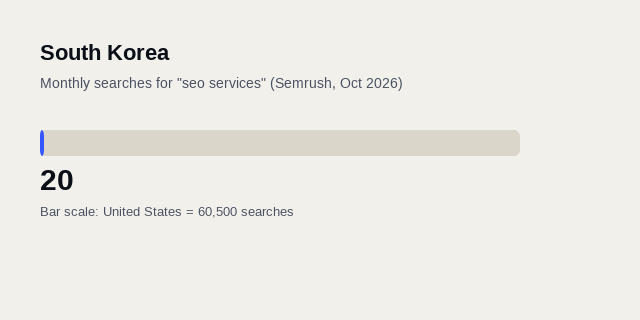
- Local search demand: about 20 monthly searches for "seo services" in the South Korea database (Semrush, October 2026).
- Language context: Korean.
- Naver is a major local search engine alongside Google, and its results favor its own content platforms, so a Korea plan needs more than Google tactics.
- Working overlap with South Korea: about 5 hours a day
- Every enquiry gets a reply within 1 business day from the person who would do the work.
The Search Market in South Korea, in Numbers
| Keyword | Searches per month in South Korea | Average CPC | Difficulty |
|---|---|---|---|
| seo services | 20 | $1.59 | not enough data |
Source: Semrush Keyword Overview, South Korea database, October 2026. English phrase only. A count of 20 is the lowest figure the tool reports.
Semrush reports about 20 monthly searches for "seo services" in the South Korea database, which is the lowest count the tool shows, so treat it as little or no measurable English demand. This page exists for businesses in South Korea that already know they want help and for campaigns we run toward the market. It is not a promise of organic traffic.
What Makes South Korea Different for SEO
A Korean language market where the local search engine Naver is as important as Google for many queries. Main business cities include Seoul, Busan, Incheon.
- Language. Korean.
- Search engines. Naver is a major local search engine alongside Google, and its results favor its own content platforms, so a Korea plan needs more than Google tactics.
- Currency. Local pricing is often thought of in South Korean won. Our plans are scoped and quoted individually, and you can say in the form which currency you prefer to discuss.
- Privacy. Relevant framework: the PIPA. We flag consent and tracking issues in audits and are not a substitute for legal advice.
- Time zone. Our working hours overlap with South Korea for about 5 hours a day, so live calls are easy during normal business hours on both sides. Reference city: Seoul (UTC+9 standard time). A 9:00 AM meeting in Seoul is 5:30 AM IST, and 11:00 AM is 7:30 AM IST.
What We Do for South Korea Businesses
- SEO. Technical fixes, keyword and intent mapping, on page work and internal linking, aimed at pages that produce leads.
- AIO and GEO. Structuring content so Google AI Overviews, ChatGPT, Perplexity and Copilot can find, understand and cite you.
- CRO. Improving the pages that already get traffic so more visitors become qualified enquiries.
Is This a Fit?
A good fit if you run a SaaS company, B2B services firm, ecommerce store or multi location business in South Korea, you have a budget you can commit for several months, and you want organic search and AI visibility to become a steady source of enquiries.
Not a fit if you want guaranteed rankings, instant results or the cheapest possible monthly package. Nobody honest can promise those, and the form asks about budget and timing so we can tell you early if we are the wrong match.
How an Engagement Starts
- You send the form. We read it ourselves and reply within 1 business day.
- A short call. We learn your market, goals and what has been tried.
- A free review. We check your site, search presence and AI mentions, then tell you what we would fix first.
- A scoped proposal. You choose a Starter, Growth or Enterprise track, or decide not to proceed.
Ready for a straight answer?
Send the short form and get a review of your South Korea search presence.
FAQ
SEO services in South Korea, answered directly
Do you work with businesses in South Korea?
Yes. We work remotely from Chennai, India, and take on clients in South Korea. Our working hours overlap with South Korea for about 5 hours a day, so live calls are easy during normal business hours on both sides.
Should my South Korea website be in Korean?
Match the language your buyers search in. Context: Korean. If your buyers search in more than one language, each needs its own pages, and we say upfront when a local editor is needed for production.
Which search engines matter in South Korea?
Naver is a major local search engine alongside Google, and its results favor its own content platforms, so a Korea plan needs more than Google tactics.
What privacy rules affect my site in South Korea?
The relevant framework is the PIPA. Forms, analytics and cookies on your site may fall under it, so we flag consent and tracking issues during an audit. We are not a law firm, so confirm requirements with your own counsel.
Can you show results from South Korea?
We do not claim country specific results on this page. Our published work is on the case study page, and we are happy to walk through methods and examples on a call.
What does an engagement cost?
Plans are quoted to scope rather than priced from a list. The three tracks, Startup Starter, Growth and Enterprise, are described on the pricing page. Share your budget range in the form and we will tell you which track fits.
Sources & further reading
Where this page draws from
Nearby markets